
Mask On Mask Off:
My Juxtaposed Experience Of New Orleans
Three days of laughing, partying, and indulging on Bourbon Street. Three days of sadness, burdened with a heavy heart, trying to understand how this community was left to deal with their pain and tragedy alone. They say knowledge is power and ignorance is bliss, well that rang true for me in the Big Easy.
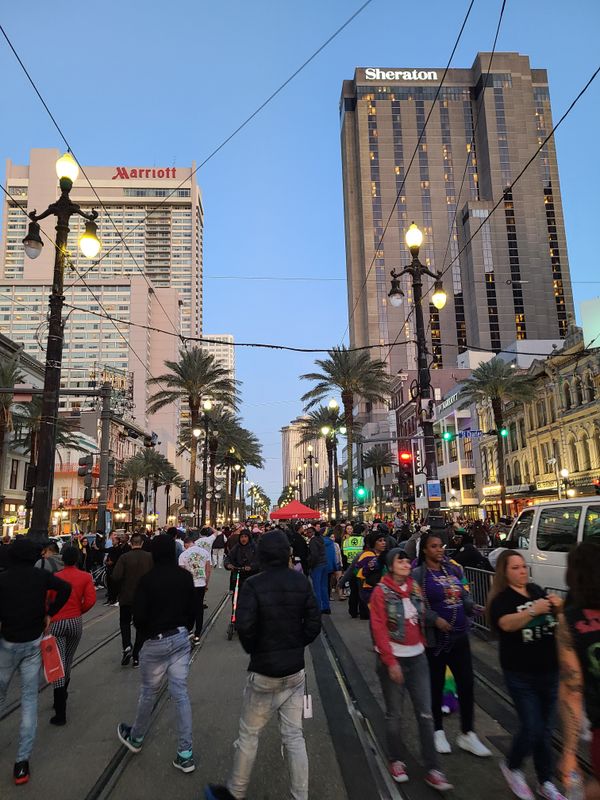
 I was so excited about my trip to NOLA, as it was my first time visiting. But I was met with an immediate pause when my flight got delayed by 3 hours. I landed at 9 p.m. on Sunday, two days before Mardi Gras. My taxi immediately filled me in on the vibe that awaited advised he would drop me two blocks from the hotel because the streets were blocked off due to the parade. Bogged down with a roller suitcase, a backpack & an oversized tote bag, I bobbed and weaved through the crowd to get to what my G.P.S. told me was 3 minutes away. Well, it took me 45 minutes to maneuver through a parade of drunken, party people and narrow spaces in my attempt to advance across the street. As my agitation level started to rise for landing right in the thick of it (after dealing with flight drama and a dead phone), a float came by playing "Back That Azz Up" and just like that, all was right with the world and I realized, this is what I came for. 13 minute read
Overdressed from the N.Y. weather, my hoodie and shirt were drenched, hair puffed up, and I was winded, but walking into the International House Hotel calmed all of that down. The owner is a fanatic for the Arts and there was artwork all over the hotel, especially Banksy. As I looked around I felt totally in my element. The concierge saw me distraught from the door and before I could speak said, "Stop, breathe. You made it here, you can relax." His assuring smile soothed me, and then he proceeded to brighten my day by letting me know because of the flight delay, not only did they credit back my flight cost but also upgraded my room to a King Deluxe Suite. One time for the southern hospitality! At this point, the next decision was to either unpack, order in, and figure out the next day, or hit the French Quarters and dive into the nightlife. Thirty minutes later, I was on Bourbon Street (no brainer). It was the first Mardi Gras celebration since Covid happened, and it showed. The energy did not disappoint. It lived up to the bead throwing for bare breasts, drum lining and dancing in the streets, and full-blown 24/7 party mode. Security was pretty on point as well. I soaked it in for about an hour and headed back to the hotel to rest up and prepare for what I was in for.
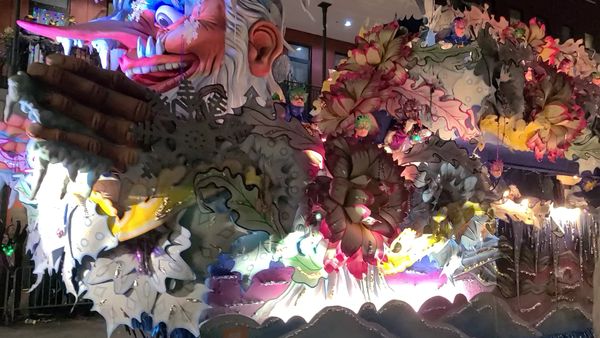
Monday and Fat Tuesday didn't disappoint with the gigantic, amazing colorful floats (some with celebrities), the school marching bands, the delicious food, and of course, the party-goers. I had my first Beignet at Cafe Beignet, tried my first Charbroiled Oysters at the Creole House, and caught some excellent jazz at the Spotted Cat. Along the way I met some great people, like the lady who let me in the Senior Home because it was the closest place to charge my phone, the Uber driver who became my tour guide free of charge, and the bartender who gave me free drinks because he enjoyed my Brooklyn vibe. After partaking in Gluttony for 2 1/2 days, I was more than okay with saying goodbye to Fat Tuesday and hello to Ash Wednesday. This is where the trip’s pendulum shifts.
I wanted to follow my tradition of going to church and receiving ashes. I researched and found out the oldest Black Catholic church in the U.S., St. Augustine, was right in New Orleans, and the first established A.M.E. Church in the South, St. James, was here as well. The G.P.S. told me it was a 20-minute walk so I figured, what a good way to tour the city while en route to my destination. Things got less party mode and more desolate as I walked past that threshold from the French quarters to the 7th ward. The streets were quiet except for the sounds of dogs barking. Now and then, I would pass a block with people hanging out or a grassy knoll area where the old heads were conjugating. One of the elders gave me a smooth nod followed by a good evening ma'am. When I got to St. Augustine, my first impression was that it was huge. The first thing I noticed was a homeless person lying on the steps. Due to covid, the service would not be in the sanctuary but the hall area. I sat in on the service, received my ashes, and left shortly after that trying to beat the sun as I headed to the next location, St. James A.M.E. Upon entering the beautiful sanctuary, I was met by such warm hospitality. I enjoyed the service, but after that first night of wandering out of the Quarters, I found it interesting that the historically Black landmarks were in such neglected areas.
 Next on the agenda was Louis Armstrong Park, another place I walked to, located in Tremé, the 6th ward, and considered the oldest African-American neighborhood in the United States. I was immediately drawn to Congo Square, where a sculpture depicted how enslaved people would gather there on Sundays to sing, dance, and drum in authentic West African style. The park itself was beautifully filled with sculptures of famous blacks, including, of course, Louis Armstrong. The space was vast with bridges to walk over, a beautiful fountain overflowing into an artificial lake inhabited by swans, and the Mahalia Jackson Theatre of Performing Arts. But again, I couldn't help but be aware of the contrast to the neighborhood once I exited the park. It started to feel less like a coincidence and more like a pattern that all of the historical black monuments I wanted to enjoy were in the downtrodden sections of Nola, but I got a better understanding of why when I stumbled upon Albert & Tina Small Center for Collaborative Design in Central City.
 I was greeted by Aron Chang, who welcomed me with open arms to view the exhibit. Aron Chang, Adjunct Lecturer and Urban Designer, and Jose Cotto, Collaborative Design Project Manager at the Small Center, gave me a crash course in the history of the community. Aron guided me around the visual arts that expressed the state of the community. There was a wall of framed photography set up in the form of a cross. The bold imagery of costumes, parades, and the people lit up the white-washed wall, echoing the sentiments of the New Orleans spirit I had experienced the past couple of days.
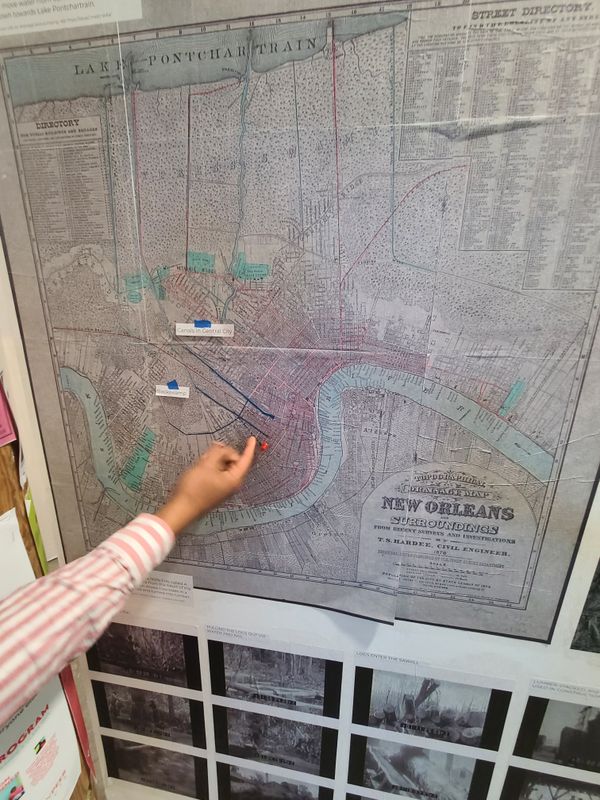
Then Aron directed me to what looked to be a 5' x 10' board (definitely a guesstimate) that was a map filled with over 40 churches. The goal of the exhibit was to show how the culture, the church, and the civil rights movement all worked hand in hand to create the rich history of this colony of people. I told Jose how I noticed that the Black neighborhoods appeared barren. I inquired about the church's role in the community and if they were helping the situation. He reminded me that since Katrina, many churches weren't active and that the demographic shifted, and a lot of people moved out of the district. The government put no money into rebuilding these locations, which were predominately occupied by Black middle to lower-class residents. Also, because of the risk and property value, no banks would even provide loans to this region to assist in the rebuilding. Which then brought him to the discussion of redlining.
Public housing was demolished by the Home Owners Association in the 1930s-40s, forcing people out of their homes in the supposed efforts to create residential security. In the increasing demand for housing, what is known as "Shotgun houses" became popular for these tenants to live in. Now the same communities are being gentrified and inhabited with fewer people of color, or they remain dilapidated. Redlining effects are still felt to this day and are evident by the climate of the neighborhoods. My heart sank as I saw how they were set up to fail, a forgotten people who the government chose not to invest in. I felt even worse knowing all I had to do was walk twenty minutes in the other direction, and it was filled with no regard for the situation at hand. I'm from New York so I'm no stranger to these conditions, it just hit a little different, taking into account the multiple disasters they've had to face.
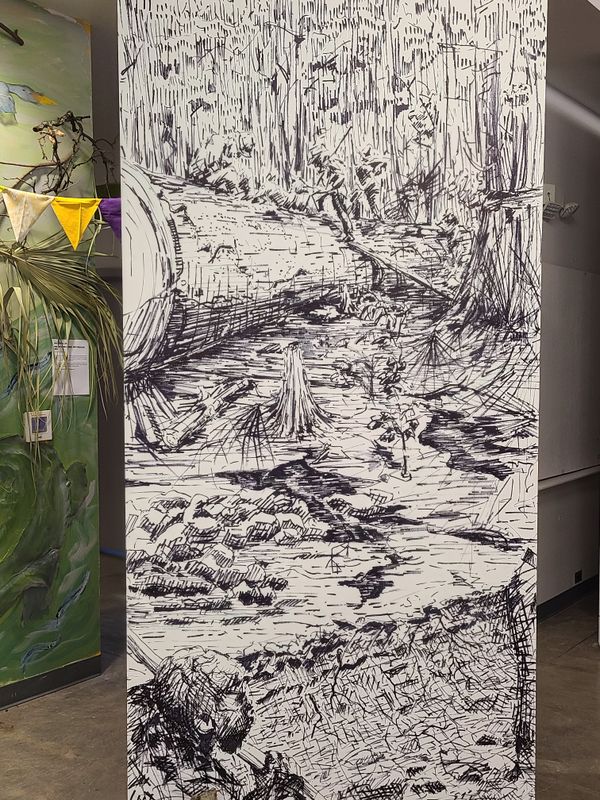
 The Ashé Cultural Arts Center, which was right around the corner, lifted my spirits as it was a place that displayed the thriving culture and art in the heart of New Orleans. Again, these two places showed me how pain and pride inhabited the same space. As I shared this thought with one of the staff members, she replied, "But that's what us as a people do right? We push through. We are a people of resilience."
At this moment I realized I had an extreme comprehension of New Orleans: Either the wild jovial celebration of Mardi Gras or the Katrina and the Levees disasters. And the history I did know, I totally glossed over the fact that it took place in New Orleans, but now I was pounding the pavement and putting my finger on its pulse.
The Levees and the Flooded Museum Exhibition put me on another emotional roller coaster. As my Uber dropped me off, I immediately noticed the change in the neighborhood. It was well kept and the first house I saw had a boat in the driveway. I was like okay, this is different from what I've seen so far. As I went up to the open-spaced exhibition site set on a large piece of land, I saw benches, flowers planted along the way, a mailbox that said NOLA, and what looked like panels housed in a 100-foot covered walkway. The Levee Exhibit Hall is located at the east breach site of the London Avenue Canal. Water from the breach had pushed the home that once stood there, foundation and all, into the street. My mind went back to the boat I saw and realized that it might not be for recreation but preparation. There was no one there but me, and I took my time reading all six panels and viewing photos documenting the events that led to the levee breach. I had never seen the images they provided, and to be standing in the exact location that was part of the tragedy, I just had to sit and take it all in.
I looked to the left and saw a couple more homes, but these were different than the other ones in the community. These homes were never rebuilt after the effect of the flood. The cars were damaged in the driveway, and as I peered through the abandoned houses, I saw everything turned upside down. I could see the piano flipped halfway against a wall, broken glass everywhere, and furniture that looked decayed, there was a haunting aura and I had to step away. My mind had become far removed from the drinking, the bead throwing, and the excitement of dancing on Bourbon Street.
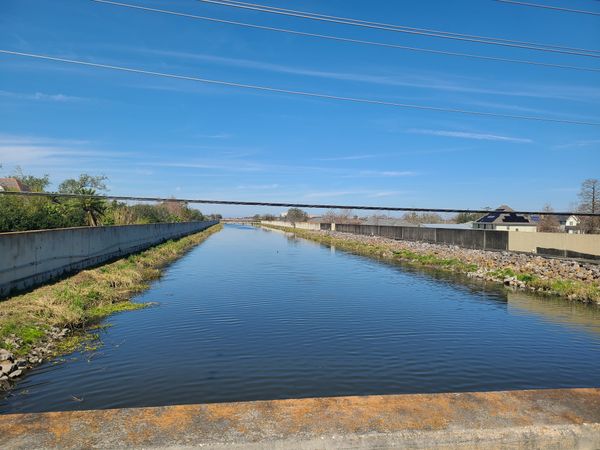
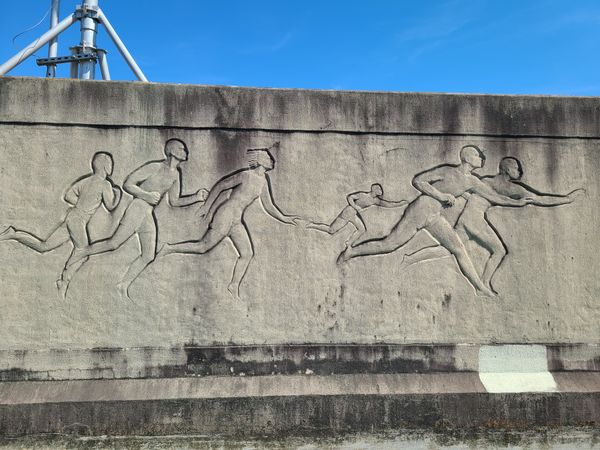
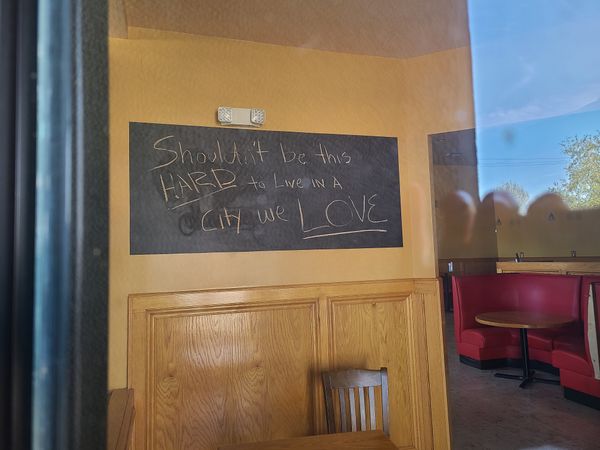
Departing from the location, my Uber picked me up and the driver inquired about how I felt about the exhibit. He led off with an interesting question, "So do you believe what they told you about why the levee broke?" Finding the question odd, I told him it discusses the poor design of the levees. The same thing everyone else says. He then told me, "No, that's not where it started. Do you remember when everyone kept asking where the National Guards were? I was a part of the National Guard and stationed in Iraq. They deployed us back here when it happened because they needed to cover up the huge accident that caused the levee to break." I hadn't heard this story, but I'm always up for another perspective to verify. He continued, "A Bard ship that wasn't properly docked let loose and crashed into two homes in the 9th ward, and the impact of that was what caused the levee to break. They had us guard it so that the media wouldn't catch it while they got it out with those big cranes." Now I was confused. "How could they silence the people that were living there from saying anything. That doesn't make sense," I said. "No one was living there after Katrina, that's why. Whoever owns that company had a lot of connections or power because no one speaks about it. Not the place you just came from, not even the museum." I was stunned! I immediately googled it and the story checked out! How is this known information but not documented when telling the history of this tragedy? Another moment where history is being rewritten to save someone's ass.
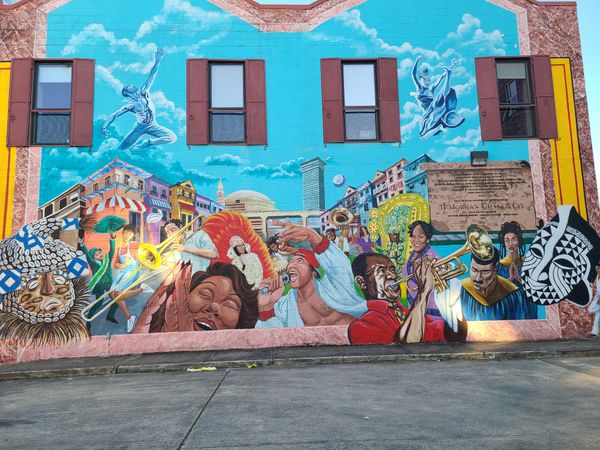
I had indeed gotten more than I bargained for in NOLA, but the roller coaster wasn't over. I am a total lover of the arts, especially street art, and if you want to see the heart of the N.O. captured in a drawing, you have to visit BMike’s Studio, Studio BE. This was it for me, the final straw. The past three days of history learning were so overwhelming that seeing the stories being told through art forced me to break down and cry. One of the most touching pieces portrayed the New Orleans Chapter of the Black Panthers' Pad that got shot at for over 20 minutes straight. On the wall were photos of the event, and as you turn to your right there were two panels reminiscent of the house (I haven't confirmed if the pieces were actually from the pad). It struck a cord to the core as through the bullet holes, you can see a T.V. playing a documentary reliving that day.
In the middle of wiping my tears, my eyes caught sight of a gentleman in a lime green shirt walking out of the Employees Only door, and it was BMike. I approached him to inquire about his identity and he cooly confirmed with a humble head nod that it was indeed him. I asked for a picture, and he said of course. I directed him to one of my favorite pieces for the photo op, Ruby Dee & Ozzie Davis. A couple that gave black love hope, and their wisdom shined every time they graced the screen. That painting evoked strength for the future, something to strive for and that's why I wanted the picture in front of that piece.
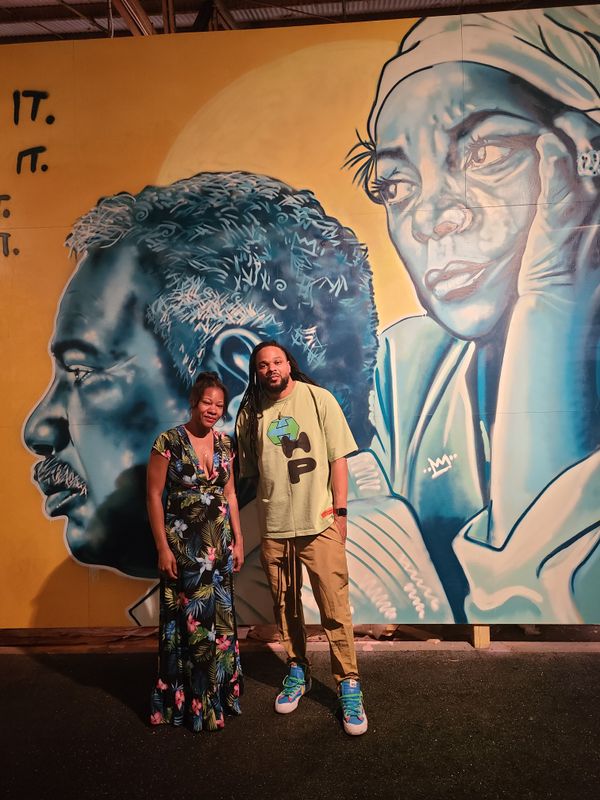
 I met the man who was being a voice of the past, present, and future through his work and I was grateful. Recapping BMike's studio is another story within itself, so I just highly recommend you go and see it for yourself. Not only is there history on the interior, but a block away from the studio is the corner where Homer Plessy was arrested when he refused to move from a "whites only" railcar in 1896, sparking the infamous Plessy vs. Ferguson case.
This was my last stop on my last day (or so I thought). I had a late flight, and after that emotional moment, it was time to head out, gather my things from the hotel and go to the airport. My Uber arrived, and this ride turned out to be just as unexpected as the rest of my trip. I don't usually talk to the drivers too much, but something about NOLA made me a little softer than I usually am in N.Y. As we started talking, I recapped my history lesson from the past three days, and he put me on to about ten more places that I didn't even know existed. This had me stressed as I wanted to do so much more now! Then he said, "Hey, how about you add the Airport to your stop, and after we pick up your things from the hotel, I'll take you to a couple of places along the way free of charge." God was all up and through this trip just making a way for all of my desires, and I proceeded to do so. As I entered the hotel, I was greeted by the same concierge gentleman as when I arrived in distress on that first day. We had come full circle as he helped me with my bags and said, "You better come back and see me," and I obliged.
With an hour left to get to the airport, my driver took me to see the Tree of Life, the oldest tree in New Orleans. This was one of the most beautiful trees I'd ever seen, biblical even. He said the folktale goes that if someone wants a child, they come here and touch the tree and bring new life into the world the following year. The way God works, I don't know what plans He has for my life, but I had to touch that tree, become one with that tree, and of course, take some amazing pics with that tree. I'll let you know how true the tale holds up, check in with me in about a year, lol.
 And with that, I was headed to the airport. As the Uber ramped onto the highway, I looked out to the colorful city, a place I had grown to adore and was now leaving behind. Going from day one, I reflected on my experiences of the cheerful Masks On down Bourbon Street at Mardi Gras, and the disheartening Masks Off crossing that threshold of the French Quarters into the history of its desolated areas. I initially felt a sadness, feeling foolish even for finding enjoyment in the very place people were hurting. But then I realized New Orleans is a place of resilience, and rich culture, who live in pride and not pity, amid the pain they find their power. They celebrate despite their circumstances because they don't let it define who they are, and that in itself is a reason to celebrate.
‘Til we meet again NOLA, Laissez Les Bon Remps Rouler - Let The Good Times Roll!
Follow Artist BMike on IG @bmike2c or check out his website www.bmike.com